Written by Natalia DeLaCerda
I had been dreaming for months about my upcoming hike to the top of Half-Dome in Yosemite, a granite rock formation sitting above Yosemite Valley at roughly 8,844 ft of elevation. I had fallen in love with hiking 5 years prior after stumbling onto a challenging trail that gained 1700 feet of elevation in less than a mile. I quickly became a regular among the fire fighters, SWAT team members, and Navy who continually train on it, and on average I do the hike 4 days a week. To prepare for Half Dome, on a daily basis I began looping my beloved trail twice, completing an hour of Pilates, and adding 4 miles on the treadmill. I didn’t want to just hike Half Dome, I wanted to feel good hiking Half Dome—not beat up and exhausted like I didn’t belong.
I had a few days break from my accelerated BSN nursing school program, and after finishing my last final of the term, made the 6-hour drive to Yosemite National Park– Half Dome permit in hand. At 4am on Monday, August 14th, 2023 my alarm went off: the hike to Half Dome was finally here. Throughout the hike I felt good, I didn’t need to stop and rest or take breaks and whether it’s true or not, by the time I got to the top, I felt like I could have done it a second time over without a problem. My training and preparation had paid off, and with each step I was free to take in the overwhelming wonder and majesty of Yosemite. It will forever be one of the great honors of my life.
After about 4 hours of hiking, I reached the sub-dome just before the top of Half Dome. What I had not prepared for was the problem I encountered as soon as I set foot on the narrow set of steep switchbacks made of rock– I suddenly began to lose my sense of equilibrium. It felt like I was teetering, feeling oddly too tall to be safely navigating the steps without toppling over. I dropped down to the ground, confused, finding myself holding on to the sides of the rock as the earth seemed to sway and swirl back and forth. I had never had a fear of heights, and I wasn’t sure if that’s what was happening. I began to crawl on my hands and knees up the switchbacks. I replied to concerned fellow hikers that I may have discovered I have a fear of heights, but that I was determined to at least make it to the cables. With words of encouragement all around, I crawled my way to the cables. Just before you get to them, the switchbacks turn into smooth rock and it’s a steady climb to their start, which felt better to me than the switchbacks— at least I was able to stand upright without feeling like I was going to fall over.
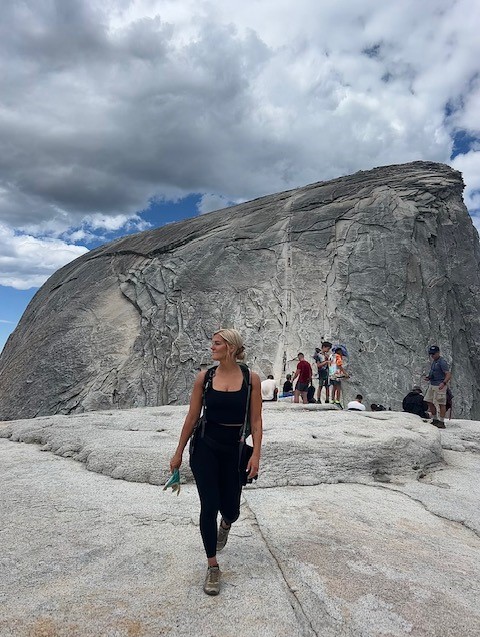
Once there, I surveyed the dome, standing among fellow hikers captivated in deep admiration– humbled in the presence of such profound power. The dome is massive, and as my gaze swept across its legendary face I felt insignificant and yet completely whole, like every free space inside of me was filled and overflown– a concept of beauty I was incapable of understanding until that very moment. It felt like the most magnificent representation of the secrets hidden deep within the universe, and I was about to be a part of it. I had made it, and all that was left to do was scale the cables to the top.
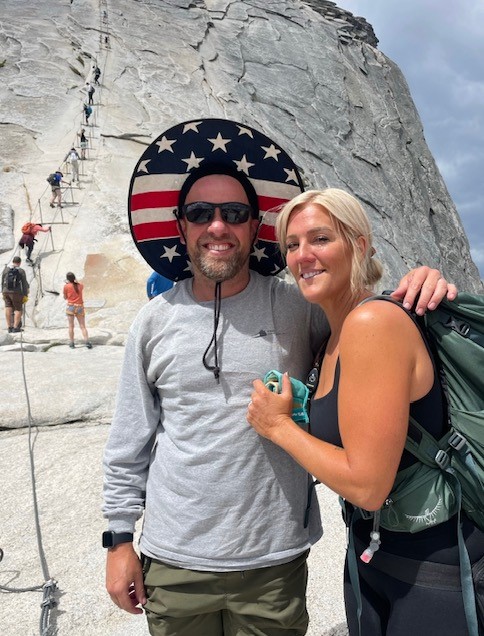
To be honest, the cables always looked extremely dangerous to me. I couldn’t quite understand how so many people were able to complete them without issue. The 45-degree slope to the top is a 400-foot vertical climb, impossible without the addition of the cables. It takes about 20 minutes from the start of the cables to the end, and climbers pull themselves up by hanging on and stepping onto the widely spaced small wooden planks that lay across. There is no climbing equipment, there is no safety harness, and there is nothing preventing you from falling off if you put a foot wrong. It seemed too steep and the wooden planks seemed too rickety to be safe. I had read that if you slip and slide outside of the cables, you are likely to fall to your death. And, more importantly, there was no help available but the mercy of fellow hikers if something were to happen. And yet, so many people do it, and because of this, I thought, it must be easier than it looks.
I was nervous about those cables though, and months leading up to the hike I asked several people about their experience. The typical response was something like, “I did them when I was 10, you can totally do them.” I wasn’t sure, “What about the 9 people who have fallen off of them and died?” There was usually an eye roll, and then a well-meaning “You’re going to be fine.” Soon, a clip of a 93-year-old man reaching the top of cables circulated on the internet and found its way to my inbox on almost every social media platform I’m a member of. People wanted me to know that I wasn’t going to have difficulty.
I looked down at my legs. Was I sore or fatigued? No, physically, I was fine. But, was I okay? What had happened to me on the switchbacks? Am I still unable to find my balance? I thought of that 93-year-old man as I picked up my gloves and began to put them on. I reasoned with myself: I will just put my hands on the cables and see how it feels.
What the switchbacks did not have was something to center yourself on, so as soon as my hands were wrapped around the cables, I felt much better and in control again. I took a step. This felt safer than the sub-dome. I took another, and another, and I began to climb. Pretty quickly into the ascent, the shuffling of people up and down the cables paused, and people started to complain. “What’s the hold up? Keep it moving!” Pretty soon it became apparent a woman was having difficulty getting down. The man behind me grew frustrated and told his son to climb back and get off, because he didn’t want his arms to fatigue while waiting for this woman to make it down. Before they left, the man shouted at her, “One person has to ruin it for everybody!” to which several hikers around me agreed. I thought back to my own reservations about the cables and remembered that the only help was the mercy of other hikers. As I stood hanging on and watching the woman struggle, I realized something that had not occurred to me before: There was no help. There was no mercy. The woman in trouble was on her own entirely, and so was I.
Slowly, she made it down. I watched her, mostly because now I had the time, but also to note her technique, as I was unsure how to climb down. I saw her cling to one side of the cables with both hands and shimmy down. I also saw her switch tactics, and face forward, leading with her feet and securing the cables in each hand. The third method consisted of climbing backwards and looking over her shoulder. Though she moved slowly and fearfully, she was able to switch from tactic to tactic and painstakingly inch her way down to the bottom.
The flow of people began to move again and I was free to continue the climb. I was able to move up quickly, and I remember feeling powerful and strong– this is my kind of fun, this is me in my element. It began to get very steep, and as the steepness increased, I started to lose control of my equilibrium again. I clung tighter to the cables and began coaching myself: Focus on what is directly in front of you… look at the right cable and climb up, look at the left cable, and climb up. I began to count: One, two, three. Each step was a count. Focus on the count, Natalia. One… two… (the world behind the cables started to spin faster and faster)… three. One… two… I took a deep breath. I took two deep breaths. I could not stop the spinning from happening, and I became hyperaware that I was unable to control what I was experiencing. I tried to get very clear about what I could control because suddenly this felt like a race against time, I had to get off the cables as soon as possible.
I did not feel like I would be able to look backwards without falling, and I was likely already past the halfway point, so I decided to climb to the top as fast as I could before the spinning caused me to let go. I climbed quickly, but panic had set in. I could feel a woman behind me, and I told her, “I’m starting to lose it a little bit.” Confidently, she said, “You’re doing so good, you’re almost there!” I asked myself out loud if I should go back, and she called out to me, “Don’t go back, step up and you can almost let go!”
I did not let go. If I let go, I knew I could not get back on. I quickly decided to climb down and get off as fast as possible without having to get off and back on again. I began to climb down, even as the woman insisted, “But you’re right there!”
As I started the descent, I began to lose any sense of control I had been able to maintain on the way up. The panic was getting stronger, and despite my counting, my breathing, and my coaching everything was getting worse. If these things don’t work, I thought, the consequences are that I fall off and die. I must keep counting, I must keep moving my feet, I must keep moving my arms. One… two… three. My foot began to slip, and I pulled myself up on the cables while struggling to steady my feet—the rock seemed to be spinning so fast that I was having trouble finding it. I called out, “I need help, I… I can’t do this!” I focused in on my hands, I willed them to move down the cable in unison with my feet. They did not move. I looked at my feet, move your feet Natalia, move your feet… they did not move. I counted: one… two …three… but I could not move. There was a disconnect from my command to its execution, and I was left paralyzed and unable to move as I clung to the cables, the world spinning around me at 100 mph. I felt disoriented– was I facing up or down? Were the cables spinning in midair? The transition from panic, to panic attack was complete, and I was stranded— sensing correctly that no other hiker was near.
I knew despite my grit, determination, and physical strength that this was not something I could fix. I could not will my way through the tricks my mind was playing on me. I knew it was unmanageable. I knew I was not going to make it back to safety. There was no help, there was no mercy. I understood that at that point, I was hanging on, waiting for when to let go.
The question in my mind became, when? Is it now? Will it be in 15 seconds, or can I hang on for another minute? If I can just hold on a little longer, I pleaded with myself, I can come up with a plan for the inevitable 4,700 foot plunge to the valley floor.
I cried out in surrender, “I… I… can’t do this… I am unable to do this… I’ve lost my mind.”
A man’s voice rang out from the top of the cables: HOLD ON, I AM COMING TO YOU.
I held on.
He climbed to the outside of the left cable to bypass the climbers between us and with both hands on the left cable, made his way down to me and asked my name.
Natalia, my name is Kyle. You are not alone, and I am not going to leave you.
You are not going to fall, and I am going to get you safely off these cables.
I need you to hold on, as I do that. Can you do that?
I could do that.
You are going to feel me climb over the cable and get behind you. I need you to hold on as I do that. Can you do that?
I could do that.
You are going to feel me place my hand on the back of your pack, can you feel that?
I could.
Good. Now Natalia, I need you to listen to everything I say. I am going to tell you exactly how to move your feet and your hands and I am going to walk you safely down. The wooden planks are 8 and 16 feet apart, so I am going to tell you whether we have 16 feet to go before we can rest, or 8 feet. Do you understand?
I understood.
I want you to look down by your right shoulder and see that I am making a plank out of my foot.
I want you to take your right foot and step onto it, just like it’s one of the wooden planks. Can you do that for me?
I did.
Good. Now slide your hand down the cable. I am going to make another plank with my left foot, can you hold on while I do that?
I could.
Good, now look down over your left shoulder and place your left foot on mine, just like it’s one of the wooden planks.
I did.
Good. We are going to do this the whole way down, resting at the wooden planks. Can you do that for me?
We repeated this sequence several more times and inched our way down.
We reached a small ledge in the granite, and he instructed me to place my feet on it and rest. He said I was going to feel him climb outside of the cables, so that he could rest on the ledge as well, but that I would feel him holding my pack.
I felt him holding my pack, and we rested.
Kyle and I inched down the remainder of the cables this way until I was able to drop to my knees, off the cables and on land again.
Through tears, I repeated over and over again, “You saved my life.”
Divine intervention, he said.
But you saved my life, YOU. You saved my life!
Though I did my best to express my gratitude for the gift of life he gave me, I did not get Kyle’s last name. I did not get his phone number, his occupation, his place of residency, or his social media handles. And it feels absurd to me that Kyle may be out there working his 9-5 job on a Tuesday like this never happened, like he didn’t risk his life to save mine, like he isn’t a hero in every sense of the word. It feels absurd for him to be walking around without being celebrated as the very best of our humanity.
It feels absolutely absurd.
I’ve been finding myself waking up screaming, left paralyzed and stranded on various versions of suspended cables, this time with no one there to save me.
Sitting across from my therapist, I asked, what do I say to myself when these night terrors or flashbacks happen?
She smiled, “Kyle gave you what to say”:
You are not alone, and I am not going to leave you.
You are not going to fall, and I am going to get you safely off these cables.
I need you to hold on, as I do that. Can you do that?
I can do that.

 heymissfay